Internal vs External Audit: What Your Business Needs
6 min read • Audit Strategy • OPU KSA
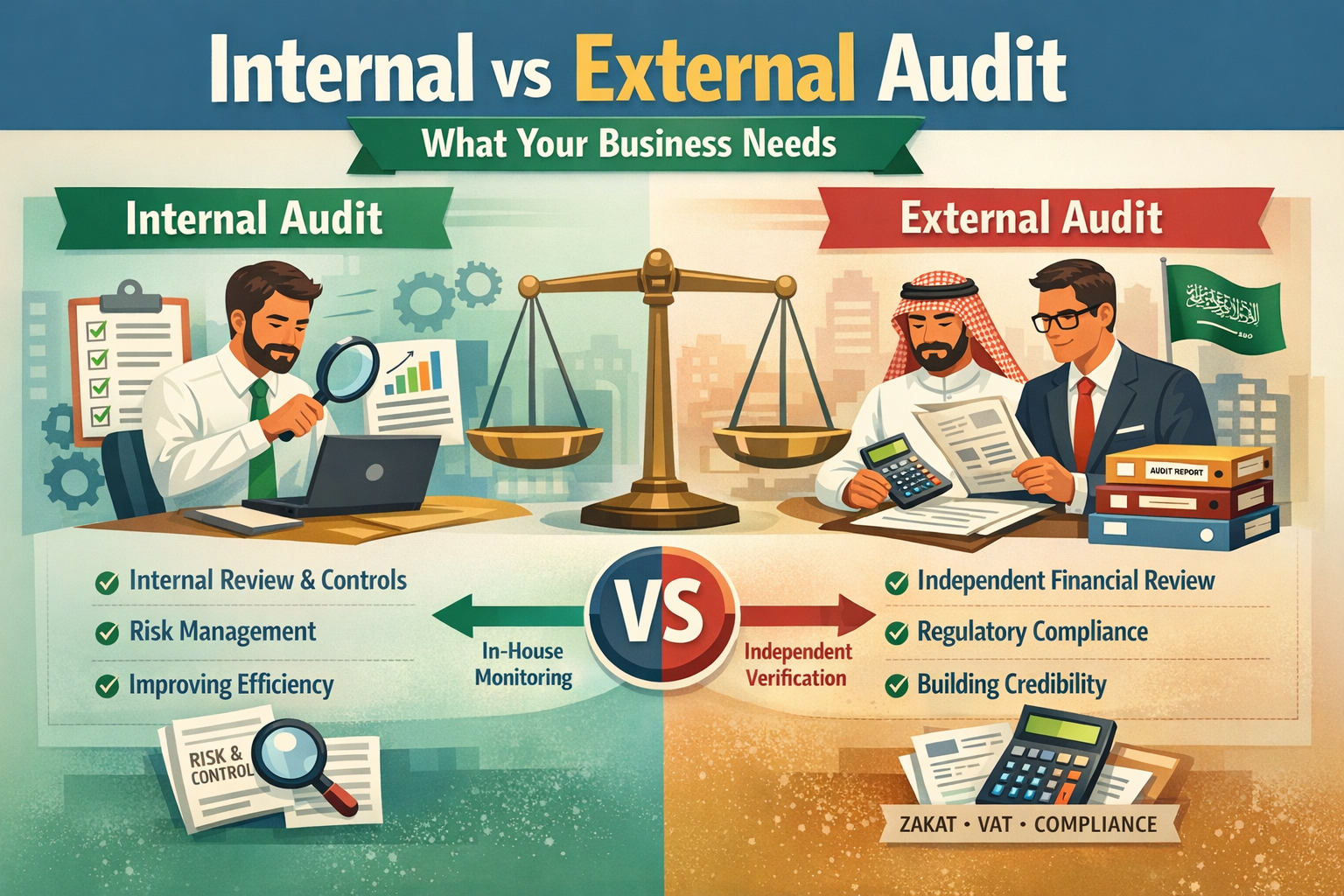
For any business in Saudi Arabia, keeping accurate financial records is vital. Audits play a crucial role in this process. However, many business owners are unsure about the difference between internal and external audits, as well as which type their company truly needs. This guide clarifies both kinds of audits and their benefits for your business.
What is an Internal Audit?
An internal audit is carried out by a company’s own staff or a hired consultant. Its goal is to review your internal processes, financial systems, and risk management practices. Internal audits provide a forward-looking perspective, helping management strengthen controls before issues escalate.
Key Benefits of internal audit include:
- Detecting errors and fraud early
- Ensuring internal controls work well
- Improving efficiency in financial operations
- Preparing your business for external audits
Internal audits are ongoing. They allow management to make informed decisions and help the business run smoothly. For instance, a retail company in Saudi Arabia can use internal audits to assess inventory controls and prevent losses.
What is an External Audit?
An external audit is performed by an independent accounting firm. Its main goal is to confirm the accuracy of your financial statements and ensure compliance with Saudi regulations, including Zakat, VAT, and corporate tax requirements. External auditors issue an official opinion that stakeholders rely on.
Key benefits of external audits include:
- Building credibility with investors, banks, and partners
- Meeting legal and regulatory requirements
- Offering an unbiased assessment of financial health
- Identifying risks that internal audits might miss
For example, a foreign-owned business in Saudi Arabia may need an external audit to meet the requirements of the Ministry of Investment (MISA) or other regulatory bodies.
Key Differences Between Internal and External Audits
| Feature | Internal Audit | External Audit |
|---|---|---|
| Conducted by | Company staff or hired consultants | Independent accounting firm |
| Purpose | Improve internal processes and controls | Verify financial statements and compliance |
| Frequency | Ongoing, throughout the year | Usually, once a year |
| Legal Requirement | Not mandatory, but highly recommended | Often mandatory depending on regulations |
| Benefit | Helps management with decision-making | Builds credibility and satisfies authorities |
Which Audit Does Your Business Need?
Most businesses gain advantages from both types of audits. Here’s how to decide based on your company profile:
- Small to medium businesses: Internal audits can streamline operations and prevent errors. An external audit may be needed if investors or banks require it.
- Large businesses and publicly listed companies: Both internal and external audits are essential. Internal audits maintain control, while external audits ensure compliance and credibility.
- Businesses planning expansion or seeking investment in Saudi Arabia: An external audit can boost investor confidence, and internal audits can enhance operational efficiency.
If your startup or enterprise operates in regulated sectors (Fintech, healthcare, government contracting), an external audit is typically a non-negotiable requirement. Meanwhile, internal audits help you stay audit‑ready and avoid last-minute surprises.
How OPU Can Help
Starting or running a business in Saudi Arabia comes with complex financial and regulatory demands. OPU offers professional internal and external audit services tailored for Saudi businesses.
We can assist your business by:
- Setting up internal audit systems that align with your operational risks
- Conducting thorough external audits for full compliance (ZATCA, Zakat, VAT, Corporate Tax)
- Preparing for VAT, Zakat, and corporate tax obligations with robust audit trails
- Identifying operational risks and recommending improvements through management letters
With expert guidance, your business stays compliant, efficient, and ready for growth. Whether you need a statutory audit for the Ministry of Commerce or a custom internal audit framework, OPU delivers clarity and confidence.
Conclusion
Both internal and external audits are important, but they have different purposes. Internal audits work to improve business processes and prevent errors, while external audits provide an independent review to meet legal and financial requirements.
By understanding the differences and applying the right audit strategy, businesses in Saudi Arabia can safeguard their finances, build credibility, and plan for long-term success. A proactive approach to auditing also positions you favorably for funding, partnerships, and sustainable scaling.
Need clarity on your audit requirements?
Contact OPU KSA today to schedule a consultation. Our team helps you navigate internal controls, statutory audits, and ZATCA compliance with a tailored approach.
Related insights
Benefits Of Outsourcing Auditing Services v/s In-House Audits
Selecting the right audit model is a strategic crossroads for any growing company. For startups and scaling businesses...
Compliance GuideHow to Choose a Reliable Auditing Service for Your Startup
In a fast-growing ecosystem, the word "audit" is synonymous with maturity. Learn how to select an audit partner aligned with ZATCA requirements...